
Canadian Crop Update
-Monday, August 6, 2001
This analysis featured in the August 6, 2001 issue of the HGCA's MI Prospect, Volume 4, Number 3
Weather conditions in Western Canada this year have not been favourable for crop development, with drought conditions persisting in central Saskatchewan and southern Alberta. Market implications may be pronounced for barley and oilseed rape where Canada is a major player in world markets.
Key Points
Geography and climate of Canadian agriculture
About 90 percent of Canadian cereal, oilseed and pulse crops are grown in the Prairies, a triangular region about 900 miles in length along the US border and stretching 600 miles north at its western extremity against the Rocky Mountains (see Map). About 26 million hectares are cropped in this area with wheat, barley and canola(oilseed rape) contributing 41, 19 and 15 percent respectively to the total this year.
continue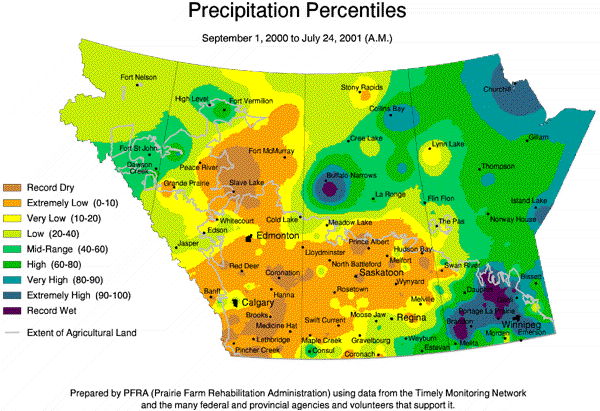
continued
Although located at about the same latitude as the UK it has a full continental climate. Winters are cold with the soil frozen from November to April and short relatively favourable summers. Almost all crops are spring seeded, mainly in May and harvested, depending on weather and typically after swathing which starts in late August, before the end of October.
The climate is quite dry, about 400 to 600 mm of precipitation per year being typical in the main cropping areas, with the spring and summer months being wettest. Prairie agriculture has adapted to this short and relatively dry growing season. It is, however, very susceptible to variations from normal weather patterns.
2001 Weather
While this year's Prairie weather may be, in a statistical sense, quite average, this is because the extremes of the east and the west offset each other. Only a very narrow ban in south western Saskatchewan and north eastern Manitoba and in the western half of the Peace River country have escaped the extremes.
Manitoba has been excessively wet which delayed seeding, but crops are now catching up. If there are concerns about Manitoba crops they relate to diseases, particularly fusarium.
Over much of the rest of the Prairies, including all but the south east of Saskatchewan and the far north west of Alberta, lack of moisture has at some stage more or less seriously inhibited crop development. Drought has already taken its toll in the worst effected areas, even though harvest is a month away for most farmers.
General rains in mid July, however, are reported to have benefited most areas, except central Saskatchewan and southern Alberta. Crop development assessments, which were being lowered every week, now appear to have stabilized.
In the only significant Canadian cropping area outside the Prairies, southern Ontario and Quebec, 900 miles to the south east, the major crops are maize and soya beans, production of which extends into the US mid west. These crops are reported to be in relatively good condition.
Harvest prospects
Formal survey-based yield estimates from Statistics Canada will not be available until late August. But several informal projections of potential yield provide a good indication of yield prospects at the time they were made. Until recently successive such projection had been lower than the one before, reflecting the deteriorating situation. They seem, however, ti have stabilized in recent weeks.
Wheat, barley and canola yields are respectively projected about 20, 10 and seven percent below average levels of recent years. These declines reflect the geographic distribution of these crops relative to the drought area, rather than their inherent intolerance of drought. They suggest harvest will be poorer than any other year since 1989.
Implications
Canada's wheat export availability, because of an increase in seeded area and a larger carry in, has only been reduced by about 3.5 million tonnes(Table). And, after allowing for smaller closing stocks, Canadian exports are only likely to be reduced by about two million tonnes, which is not significant to world trade on its own. The same is certainly the case for durum wheat where the shortfall in the 2001 crop can be more than offset by a draw down in stocks.
continue
Canadian Supply & Dispostion, Wheat, Barley and Canola
          ------All Wheat--------  --------Barley---------  ------Canola/OSR-------
          '95-'00 '00-'01 '01-'02  '95-'00 '00-'01 '01-'02  '95-'00 '00-'01 '01-'02
          5yr.avg.    est. f'cast  5yr.avg.    est fo'cast  5yr.avg.    est  f'cast

'000hct    11,168  10,963  11,295    4,458   4,551   4,482    4,915   4,816   3,955
Yield,t/hct  2.33    2.44    1.93     3.05    2.96    2.78     1.39    1.48    1.30

Supply and disposition, '000 tonnes
Prod.      26,010  26,804  21,800   13,605  13,468  12,450    6,866   7,119   5,141
Carry in    6,979   7,749   9,300    2,335   2,988   3,050      636   2,106   1,050
Imports        57      60      15       30      50      30      124     250     250
T. Supply  33,047  34,613  31,115   15,971  16,506  15,530    7,627   9,475   6,441

Exports    17,719  16,450  15,900    2,741   2,550   2,250    3,214   4,700   3,300
Dom. use    7,934   8,863   8,115   10,662  10,906  10,805    3,473   3,725   2,741
Carry out   7,393   9,300   7,100    2,569   3,050   2,475      939   1,050     400
T.Disp.    33,047  34,613  31,115   15,971  16,506  15,530    7,627   9,475   6,441

Source;  Agriculture and Agric-Food Canada, including Statistics Cananda and Canadian Wheat Board information.
Projections reflect information available at July 30, 2001.
continued
The Canadian Wheat Board (CWB) is more positive about this year's prospects than last year's for most wheat, but this is in part because it has reduced its pool returns outlook for last year.
For barley the situation is more complex. Not only has the drought reduced yield but also quality in a malting context is critical. Further, a much larger percentage of Canada's barley crop is consumed domestically. While the decline of about a million tonnes in Canadian barley supplies is small relative to global coarse grain trade, recent experience suggests that many international buyers do not regard maize as an adequate substitute for barley.
With the major barley exporters, Canada, Australia and the EU, all having at best uncertain production prospects, the expectation in Canada is that 2001-2002 will be another year of premium prices for barley. This is already reflected in both the Canadian domestic feed grain market and the CWB's Pool Return Outlook for feed barley. New crop barley prices in the domestic market have risen by almost 20 percent, the equivalent of more than £10 per tonne since April.
The malting barley situation will not become clear until after harvest, but the current expectation of the CWB, is that both 2-row and 6-row malting barley will be in short supply again this year and pool returns will increase accordingly.
A lower canola carry in and a reduced area have compounded the impact of poor yield prospects for Canadian canola supplies. Supplies are expected to be three million tonnes or about a third lower than last year. As with barley this is not of great significance in the overall global oilseed situation. But again certain markets have a preference for canola oil. New crop prices have risen by more than 20 percent, and the equivalent of £25 per tonne since April.
Dry pea production is expected to decline by about five percent with an 18 percent increase in area more than offset by a 20 percent decline in yield. Exports are expected to reduce the carry out to negligible levels.
Production of oats and flaxseed is projected to increase. Both are late seeded crops and the excessively wet spring in Manitoba may have been a stimulus for increased acreages. In Eastern Canada maize supplies are expected to rise with increased production from a larger area and better yields offsetting a lower carry in. Maize imports are expected to fall. The soyabean situation is relatively stable with a lower area offset by better yields.
Websites
- Agriculture and Agrifood Canada Market Analysis: http://www.agr.ca/policy/winn/biweekly/English/index2e.htm
- Alberta Agriculture Crop Reports:
http://www.agric.gov.ab.ca/economic/stats/listcrop.html - CWB Weather & Crop Surveillance:
http://www.cwb.ca/weather/report/index.htm - Environment Canada - weather:
http://www.msc-smc.ec.gc.ca/ - Manitoba Weekly Crop Report:
http://www.gov.mb.ca/agriculture/news/mwcr/mwcr.html - Saskatchewan Agriculture and Food:
http://www.agr.gov.sk.ca/
David Walker
phone: 01603 705153
top of page